2014年8月21日星期四

Review of Apple MacBook Pro with Retina Display

Advantages of Apple MacBook Pro with Retina Display  :


The 2014 15-inch Apple MacBook Pro offers excellent performance and a better-than-HD screen, plus a boost to its specs for the same price as last year's model.

The entry-level 13-inch and 15-inch Retina models each doubled the included RAM, from 4GB to 8GB for the 13-inch, and 8GB to 16GB for the 15-inch. Both of those models also received a slightly faster CPU, with the 15-inch model reviewed here going from a 2.0GHz Intel Core i7 to a 2.2GHz Core i7, but still from the same generation of Intel Core i-series processors (newer CPUs are expected from Intel late this year).

 Disadvantages of Apple MacBook Pro with Retina Display:


 There's very little new here beyond minor component upgrades, and the entry-level 15-inch Pro is the same price as before, even while several other MacBooks have seen $100 cuts. Higher-resolution screens are no longer a unique feature.


Design and features 


The exterior design of the MacBook Pro remains unchanged since the 2013 model we reviewed (and essentially unchanged from the 2012 original, as well), so much of the analysis we wrote for the previous model remains unchanged.
This laptop is slim, but with an expansive footprint, and it feels denser than it looks at first glance. The 15-inch MacBook Pro isn't exactly a carry-all-day-every-day package, although one could tote it around to and from work, or on day trips without much trouble.

The large glass trackpad, with its multifinger gestures, remains the industry leader, even as Windows laptops move to more touchscreen controls, at least partially to compensate for the hassle of using a touch pad with Windows 8. The ability to do easy four-finger swipes, and the no-lag scrolling in Web browsers, is something Mac users always been able to brag about to PC users. That said, some basic settings, such as tap-to-click, really should be turned on by default. Instead, I had to go into the settings menus and tweak the touchpad and accessibility settings to get the touchpad set up exactly how I like it.


 The keyboard and trackpad remain essentially the same as seen on the last several generations of MacBook. Other laptops have matched, but not surpassed, the backlit Apple keyboard, with the possible exception of Lenovo, a company as involved with keyboard research and development as any.

The 15-inch Retina Display remains a main selling point, and Apple now uses the Retina branding on the iPhone and iPad as well. Some Windows laptops now go for even higher resolutions, and it's not unreasonable to ask when we'll see this trickle down to the MacBook Air line, perhaps in the form of a rumored 12-inch higher-resolution model. The Retina screen has a 2,880x1,800-pixel display, and is at its best when displaying text or professional photography. Videos rarely go past 1080p, and most Mac games can't display higher resolutions to begin with.

2014年8月14日星期四

Review of Toshiba Portégé Z30t-A-10X Ultrabook

Display:
The 13.3-inch display shows a constant resolution of 1,920 x 1,080 pixels (166 ppi). The resulting improved sharpness and additional work space are features one does not want to miss after short time. Admittedly, the ThinkPad X1 Carbon impresses with 2,560 x 1,440 pixels (221 ppi). However, this high resolution has rather limited practical use - also because button icons of many programs cannot be scaled easily anymore.

The second innovation, the capacitive touchscreen,  should be considered more skeptically. On the one hand, one can ask whether a touchscreen is really necessary for a business laptop. That is an individual decision everyone has to make. On the other hand, the touchscreen function asks for compromises concerning the display: the screen which Toshiba calls "anti-glare" is rather a combination of normal glare and anti-glare display. Besides, sliding properties of the slightly shining coating are not really convincing. These negative aspects are however not entirely due to Toshiba, but rather a general problem of such displays.
 
 With that in mind, the Toshiba Portege Z30t that we are focusing on today is not entirely new: already at the end of 2013 we tested the compact business ultrabook, back then called Portege Z30. The new model with the "t" is based on the same chassis, but offers a full HD display with touchscreen function. In comparison with the basic version, both weight and thickness are therefore slightly increased, which is unfortunately also the case for the price: our test device with a Core i7-4500U, 8 GB RAM, 256-GB-SSD and LTE module costs around 1,550€, corresponding to around 100€ extra charge. 

Performance:  
 The Intel Core i7-4500U of the Portege Z30t is the same dual Core CPU that has already been used in the Z30. Unfortunately, Toshiba does not implement the slightly higher clocked successor i7-4510U. At the same time, the 1.8 - 3.0 GHz  4500U allows for respectable performance values, which are next to the high (turbo-)clock speed mainly due to the pro-MHz performance of the Haswell architecture. Power intake of the ULV chips is rated with only 15 Watt TDP, which is meant to reduce noise generation and temperature increase.

Processor:  
In order for the Core i7-4500U to provide the expected performance, the available Turbo Boost (1 core: 3.0 GHz, 2 cores: 2.7 GHz) has to be optimally used. While this works in an exemplary manner for the Portege Z30, the Z30t shows surprising weak points: the single-thread test of the Cinebench R11.5 is perfromed with only 2.8 GHz, the multi-thread benchmark only with 2.2 GHz. Accordingly, scores are rather bad - other notebooks with identical processor work up to 20% faster. The change between different energy profiles or the way power is supplied (battery/grid operation) does not influence clock speeds or benchmark results. 

2014年8月7日星期四

Review of MSI GS70 Stealth

Advantages of MSI GS70 Stealth:

 1. The MSI GS70 Stealth looks great, for a gaming laptop, and combines powerful hardware and a generous HDD/SSD combo into a slim body.
2.  Making small performance trade-offs to fit into a slim, attractive 17-inch body.
3. Longer MSI laptop battery  life: can work as long as 5 hours after fully charged.

 Disadvantages of MSI GS70 Stealth:

Gaming performance is a step down from the very top of the line, despite the high price. The lack of a touch screen makes it harder to use as an everyday Windows 8 laptop. Despite loud fans, the GS70 gets very hot when gaming.  

Design and features of MSI GS70 Stealth:
The design of the MSI GS70 owes a lot, in some respects, to the classic 17-inch MacBook Pro. That discontinued model, like this one, contrasts a large screen with a thin body, and uses a subtle, mostly frill-free outer shell to further deemphasize the body's large footprint. MSI claims this is the world's thinnest and lightest 17-inch gaming laptop, and the extended surface area makes it feel lighter than its 5.8 pounds (2.6kg).

The keyboard is a system highlight. It's branded by accessory maker Steelseries, and feels great, considering it's a flat-topped island-style keyboard, which isn't always everyone's favorite for gaming. The keys are large enough to hit cleanly, there's no flex even under heavy typing, and the bundled Steelseries software allows you to customize the multicolored backlights under the keys, and even assign many different macros to keys for different games. 

 
The interior of the system is also minimalist, with only a large power button sitting above the keyboard in a wide patch of empty space. If anything, there's too much negative space, and I would have liked to see some dedicated multimedia keys, such as volume controls -- something gaming laptops almost never have, despite a clear need.

The large touchpad, like most modern designs, is a clickpad-style pad, with no separate left and right mouse buttons. For gaming, you'll probably be using a mouse or game pad almost exclusively, but the pad is fine for everyday Web surfing -- although letting a finger drag near the right edge too often accidentally kicked up the Windows 8 charms bar.
 
Connections, performance, and battery of MSI GS70 Stealth :

One of the best things about using a 17-inch desktop replacement laptop is the wide range of ports and connections available to you. Despite the slim body, MSI still manages to pack in a lot, including four USB 3.0 ports, HDMI, and dual mini-DisplayPort connections. Even better, the system can drive all three video outputs simultaneously for a big multimonitor view.

2014年8月5日星期二

Review of Samsung ATIV Book 9 2014 Edition

Generally, Samsung ATIV Book 9 2014 Edition has a rare big-screen ultrabook and a premium price. 


Advantages of  Samsung ATIV Book 9 2014 Edition:
1.It is an attractive aluminum-clad 15.6-inch laptop made for mobility with a body that's less than 4.5 pounds, barely more than 0.5 inch thick, and all-day battery life. Its backlit keyboard and large touchpad are generally excellent as is its 1080p-resolution LCD.

2. Samsung's Ativ Book 9 (2014 Edition) certainly looks and feels the part of a premium ultrabook.

3.And that's really the story here with the Book 9 2014 Edition: It's a perfect laptop if you're after more screen space without entirely giving up the thin-and-light body of smaller ultrabooks.  

4.A big-screen ultrabook with a long, long Samsung battery life, the Samsung Ativ Book 9 2014 Edition delivers a high-end laptop experience

Disadvantages of  Samsung ATIV Book 9 2014 Edition: :
Given its more than $1,550 price, you may be disappointed by its lack of discrete graphics and smallish 128GB solid-state drive for storage.

The Samsung  Ativ Book 9 doesn't blend in with the sea of silver Windows ultrabooks that are available, but the gray-black aluminum doesn't scream, "Look at me!", either. The laptop alone weighs only 4.4 pounds (2 kg) and measures 14.7 inches wide by 9.8 inches deep by 0.6 inch thick (37.3 by 24.9 by 1.5 cm).
The gentle curves at the back have just enough room for its full-size HDMI and three USB ports (one USB 2.0 and two USB 3.0) as well as a headphone/mic jack, security slot, and small inputs for Ethernet and VGA out that require dongles to use (the former is included, the latter will set you back $40). An SD card slot is behind a spring-loaded door on just under the curve on the right side. 

 The backlit keyboard of Samsung ATIV Book 9 is nice, too. The larger body gave Samsung laptop room for a spacious keyboard with no awkwardly sized keys and each has a curved key cap, which Samsung says cushions finger tips. Typing does feel soft without being mushy and there's a fair amount of travel despite the shallow body.


The touchpad is large and generally responsive, though occasionally it seemed to pause while scrolling or dragging a finger across it. The surface does have a bit too much drag for my liking, which could have contributed to this. However, I didn't experience any cursor jumping and it ignored dragged palms.

2014年7月28日星期一

How To Get The Best Laptop Battery Life

Take a look at our top tips for getting the most life out of your notebook off the plug; we review everything from screen brightness to wireless card usage.

Here are some tips to teach you how to  increase your laptop battery life:

1.Reduce Your Screen Brightness
The most notable consumer of power in a notebook computer is the screen. Notebook makers have alleviated this somewhat in recent years by switching from CCFL backlighting units to LED, but the fact remains.
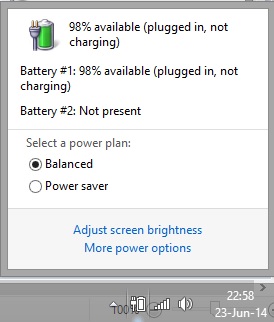
PowerIconPopUpFirst, here’s how to adjust your screen brightness in Windows 7 and 8/8.1:
  • In the system Tray, click the power plug/battery icon
  • When the pop-up appears, click More power options
  • The next screen will show you the available power plans; the one that’s currently selected will be bolded. Click the Change plan settings link next to it
  • Now you’re looking at settings specific to your current power plan. The power plan has different settings depending on whether you’re using AC power or on battery. Move the Adjust plan brightness slider to the desired position for On battery mode and then click the Save changes button to apply your settings.
We suggest you begin by moving the slider all the way to the left (minimum brightness) for the On li-ion laptop battery settings and moving it up bit by bit until it’s comfortable. Remember to keep the brightness as low as you can because even reducing screen brightness by 10 percent can significantly extend how long your notebook lasts unplugged.
One brightness setting will not fit all situations; you may have to increase the brightness in a sunlit room to make the screen usable, for example.

2.Avoid Resource-Intensive Activities
Two other leading consumers of electric power in a notebook computer are the processor (CPU; Central Processing Unit) and the graphics card (GPU; Graphics Processing Unit). The processors and graphics cards used in notebook computers are specially designed to be most efficient at lower power states; they can throttle back their operating frequency (GHz) and voltage to very low levels. They’re only able to do this however when the user is not running strenuous activities that require significant processing power. Strenuous activities include but aren’t limited to the following:
  • Photo and video editing
  • Playing video games including 3D and Flash/browser-based games
  • Playing video, especially HD
The CPU and/or GPU will use more power while performing the activities above. Here are examples of activities that require very little processing power for modern computers:
  • Web browsing (standard; non-Flash-based websites)
  • Word processing
  • Music playback
In other words, try to plan what you’re going to do on your notebook in advance while on battery.

2014年7月17日星期四

Review of Toshiba Tecra Z50 A-12K laptop

 
Advantages: The slim, lightweight Toshiba Tecra Z50 A-12K laptop still feels very premium, and it deserves credit for being one of the first Windows laptops to feature a better-than-HD display. Thanks to an updated CPU, Toshiba battery life is now good enough for all-day use. It is slim and always stays cool. Should the bosses give it an open-ended contract as soon as possible? We will clarify that in this review of the business laptop.

The material has not been changed and thus everything still has a high-quality feel here. The casing's silver-gray color merges seamlessly in every surrounding. It is well built and features an all-over high-quality feel.

 Disadvantages: Higher-res screens are more common now, and available for less. The generic brushed-metal look isn't particularly distinctive given the price.  

The screen of Toshiba Tecra Z50 A-12K is not as pliable as in the smaller model, and the base unit is just as rigid. The keyboard is still a bit too yielding though. The hinges have a fairly firm hold on the display, but they cannot prevent slight wobbles.

No compromises have to be made in the diversity of interfaces despite the slim and light casing. A Gigabit LAN port, HDMI and VGA out are all available in their full size and without a foldout mechanism. Some users will perhaps miss an ExpressCard slot, or a DisplayPort. However, a total of four USB ports are installed, three of which support the USB 3.0 standard.

Roughly 10 months later, the second-gen Kirabook aims to correct at least a few of these missteps, and thanks to a new processor and some adjustments to features and prices, it feels like a much better machine, despite offering no overhaul of the physical design. 

As mentioned, a Gigabit LAN port is just as available as a Wi-Fi module that also supports the newest 802.11 ac standard. Thus, high-speed wireless networks with a data throughput of up to 1300 Mbps are possible. Mobile Internet is also available and supports the swift LTE standard.

Toshiba does not offer many special accessories for its Tecra Z50 A-12K. Nothing but the power supply, a few instructions and descriptions are found in the box.

The port replicator that we described in the review of the Toshiba Tecra Z40 A-147 notebook costs 249 Euros (~$338). It adds six USB ports, a DisplayPort, a DVI port and extended audio ports.
 

2014年7月4日星期五

Review of Asus UX32LA-R3025H laptops

Asus Zenbook line is continually growing. In the meantime, the premium and at the same time mobile ultrabooks from Asus are available in the most different configurations. For example, with Intel's integrated HD graphics in the ASUS UX32LA-R3025H or with a dedicated Nvidia graphics chip from the latest generation, together with a Full HD screen in the UX32LN-R4053H for 200 Euros more that we recently tested. All Zenbook family members have the newest processor technology, a high-quality aluminum build, and slim dimensions for mobile use in common.

In addition to the economic Intel Core i5 4200U with an integrated Intel HD graphics and a 13.3-inch screen, Asus' Zenbook UX32LA-R3025H has even further tidbits. Besides a swift 128 GB SSD, the ultrabook can fall back on 8 GB of working memory, and a long-lasting 50 Wh battery with good runtimes.

Another advantage of this construction is found in the casing's stability and rigidity. It is not possible to dent or significantly warp the Zenbook's surface even with stronger pressure. This is also true for the display protected by an aluminum back.


 Just like the other members of the Zenbook family, the ASUS UX32LA laptop only provides an average interface diversity in all its configurations: three USB 3.0 ports, an SD card reader, and an audio jack. The Ethernet port is only included in the form of an adapter cable - likely because almost everyone uses Wi-FI at home or on the move nowadays. As to video-out, an HDMI port is combined with an adjacent mini-DisplayPort out. Consequently, the Zenbook can also deal with 4K material. An older VGA port is no longer installed, but an adapter cable is also included for this version.


Besides a slim, 65-watt power supply and the usual brochures, the UX32LA-R302H comes with both a VGA adapter for the mini-DisplayPort and and Ethernet adapter for a USB port. Asus also includes a small, yet high-quality sleeve. It not only looks good, it also protects the Zenbook from scratches and light shocks.
Asus installs a 13.3-inch screen with a native resolution of only 1366 x 768 pixels in this configuration of the Zenbook UX32LA. The resulting pixel density of not quite 118 ppi is of course higher than in 15-inch models, but considerably lower than in devices with a Full HD screen. The pixel density would be at least 165 ppi here, and would make a much sharper image possible. 1920 x 1080 pixels should be standard in 800 Euro ultrabooks, and also certainly offer the best value for money ratio. Other models also sport a 2K resolution, or even 3200 x 1800 pixels as in the case of Samsung's ATIV Book 9 Plus 940X3G. This is almost a bit exaggerated in a 13.3-inch device, especially since these pixel densities only lead to a marginally noticeable quality improvement, but a considerably higher price.